Crash the Web with One Click - Cloudflare 2025 Outages
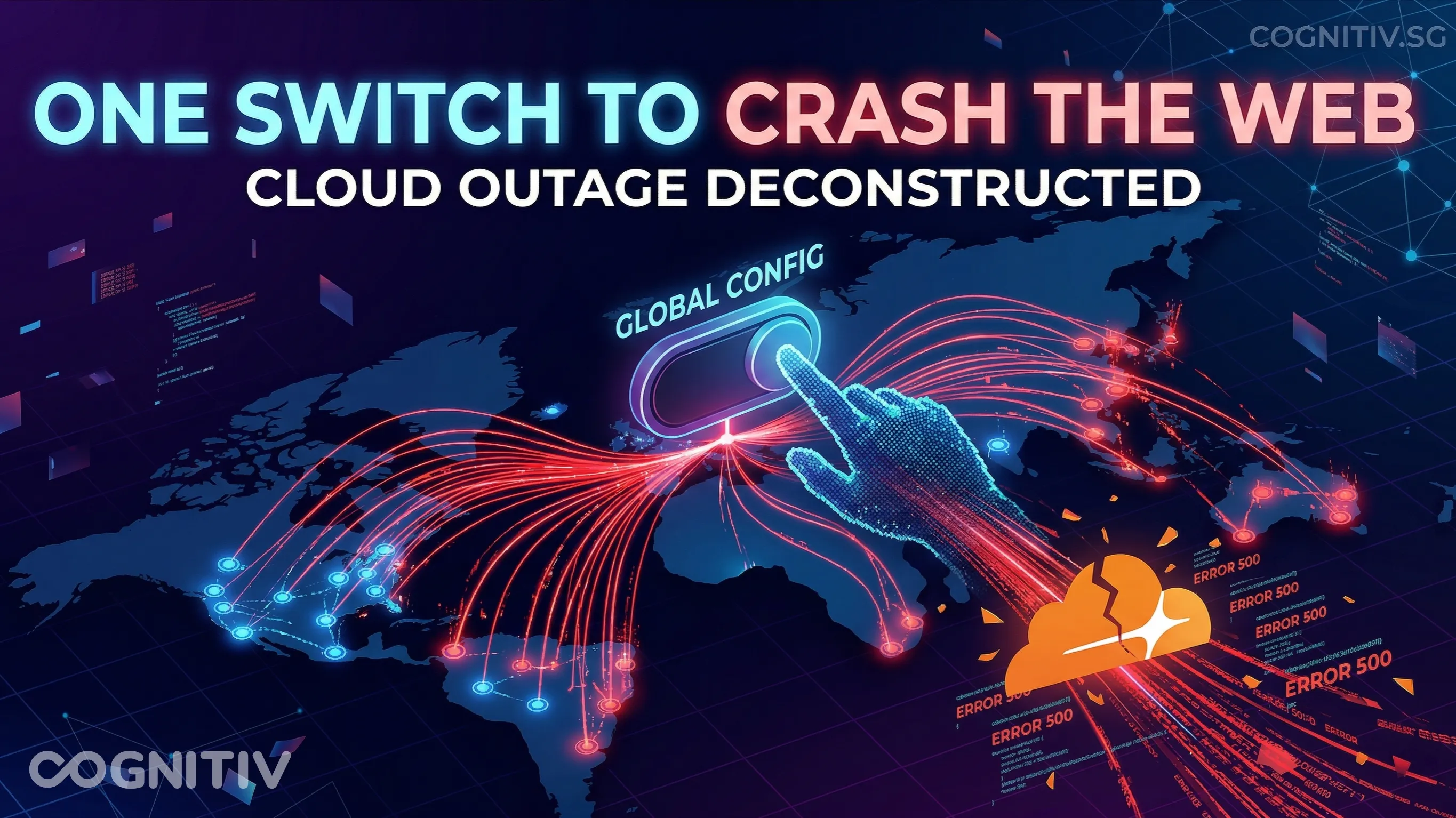
Deconstructing Cloudflare's Back to Back Outages
Just two weeks after a massive failure that crippled a significant portion of the internet in December 2025, Cloudflare experienced another global outage on December 5th. Lasting roughly 25 minutes, the incident impacted an estimated 28 percent of all HTTP traffic traversing their network.
While Cloudflare was quick to publish a transparent postmortem, the root cause highlights a recurring and dangerous architectural trap in modern infrastructure. The culprit was not a complex exploit or a massive DDoS attack. It was a simple global configuration change.
The Domino Effect
The timeline of the failure demonstrates how quickly a routine operational task can spiral out of control. The incident began when engineers rolled out a fix for a React security vulnerability. This routine deployment inadvertently caused errors in an internal testing tool.
To quickly resolve the testing tool issue, the team activated a global killswitch to disable it. However, pushing this global configuration change triggered an unforeseen bug that immediately began serving HTTP 500 errors across Cloudflare's entire edge network.
The core problem here is the immediate, network wide propagation of configuration files. In November, Cloudflare suffered a similar global event caused by a database permissions update. Following that incident, the engineering team recognized the danger and prioritized hardening their configuration ingestion to prevent immediate global rollouts. Unfortunately, implementing staged deployment systems for foundational infrastructure takes months of engineering effort, and this second incident struck before those safeguards were ready.
The Industry Wide Risk of Global Changes
Cloudflare is far from the only tech giant to learn this lesson the hard way. Pushing changes globally without progressive staging has historically been the trigger for some of the most catastrophic outages in recent memory.
In 2021, Meta vanished from the internet for seven hours due to a global Border Gateway Protocol routing update. Datadog faced a 5 million dollar outage in 2023 when a fleet of Ubuntu machines executed an operating system update simultaneously across multiple cloud providers. Just recently, Google Cloud experienced a massive Spanner database failure after a configuration policy change replicated globally in a matter of seconds and crashed every node.
The Path Forward
For an enterprise relying on a Content Delivery Network for rock solid reliability, consecutive failures are a tough pill to swallow. Recognizing the severity of the situation, Cloudflare's leadership is prioritizing strict blast mitigation to rebuild trust.
CTO Dane Knecht outlined several critical architectural shifts the company is actively making to prevent future occurrences. They are moving toward enhanced rollouts where configuration files undergo the same strict health validation and progressive deployment as core software binaries.
Furthermore, they are shifting critical data plane components to a "fail open" model. If a corrupted or out of bounds configuration file reaches the edge, the system will log the error and default to a known good state or pass traffic unhindered, rather than dropping the request entirely.
The Architectural Tradeoff
Implementing staged, gradual rollouts for every configuration change is an immense engineering undertaking. It is invisible labor that introduces friction by design. Deployments become slower, and the feedback loop elongates.
For massive global networks where stability is paramount, this friction is a mandatory investment. However, for smaller organizations and early stage products, adopting such rigorous deployment pipelines can unnecessarily stifle velocity. Engineering is ultimately about managing tradeoffs. What works for a globally distributed edge network is likely overkill for a smaller scale application.
As the dust settles on this latest incident, the takeaway for infrastructure teams is clear. Treat configuration changes with the exact same caution, testing, and progressive rollout strategies as you would a major code deployment. If your system allows a single toggle to instantly update every node on the planet, it is only a matter of time before that toggle brings the whole system down.